The bilingual signs are policy, not decoration — and Breton's legal position is unlike that of Welsh or Catalan in ways that show up on the road.
Brittany writes Kemper under Quimper on purpose
What the Signs Are Doing
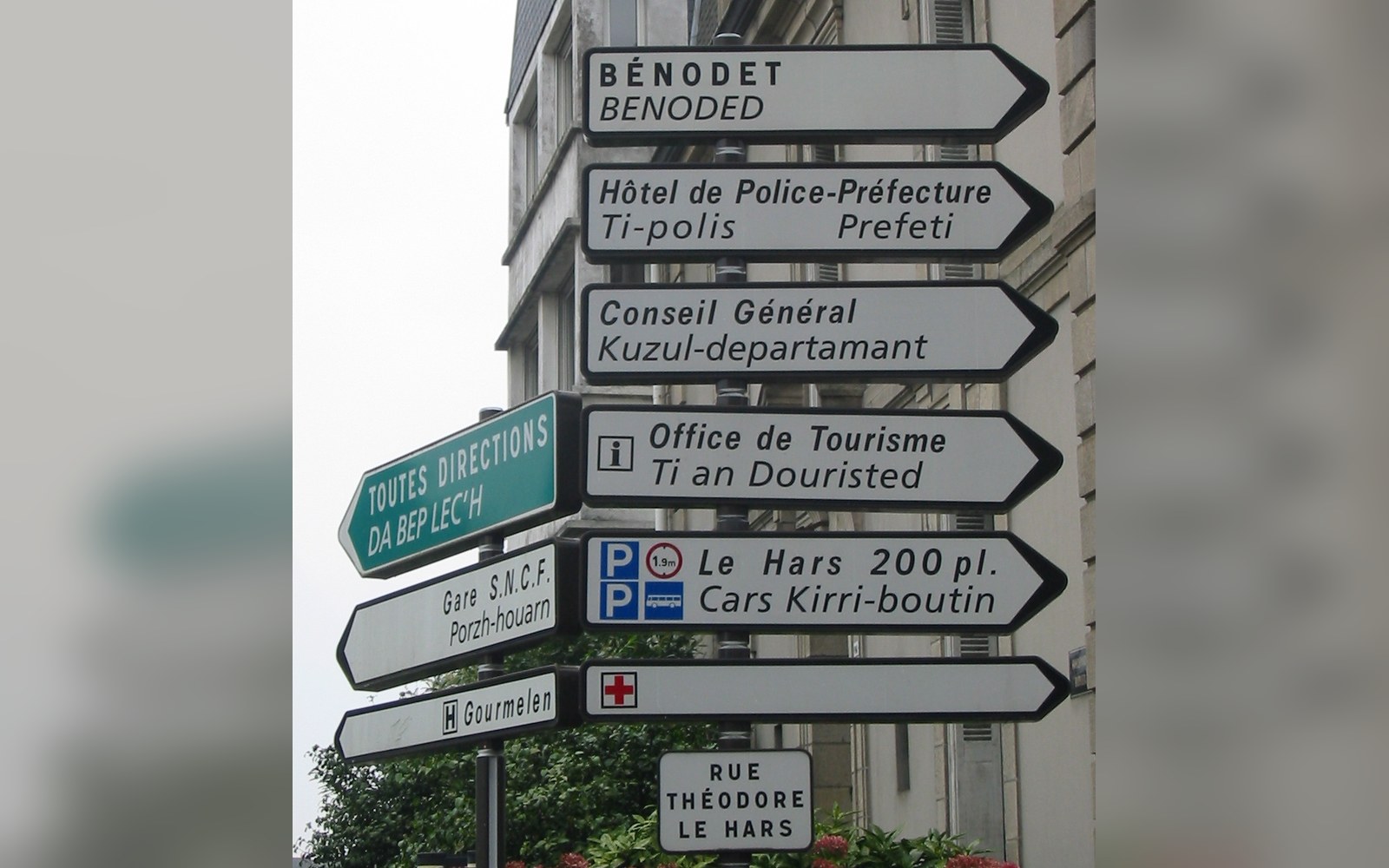
When you drive into Quimper, the road sign reads Quimper in large white letters and, beneath it, Kemper in smaller text. This is not tourist dressing. Kemper is the Breton name for the town — it means "confluence," which is exactly what Quimper is, two rivers meeting at a peninsula — and it appears on signage throughout Finistère because the département decided to put it there. The decision was a regional and local one, made street by street and council by council, because there is no national law in France compelling or even formally authorising minority-language signage. That absence is the whole story.
France's constitution, specifically Article 2, states that French is the language of the Republic. The Constitutional Council has repeatedly confirmed that no regional language can be given official co-status at national level — which is the structural reason Breton sits in a different position from Welsh in Wales or Catalan in Catalonia. Welsh has statutory co-official status under the Welsh Language (Wales) Measure 2011, meaning every public body in Wales carries a legal duty toward it. Catalan is a co-official language of the autonomous community of Catalonia under the Spanish constitution of 1978. Breton has no equivalent instrument. What it has is tolerance, local will, and a patchwork of policies whose depth varies dramatically from one commune to the next.
The région Bretagne — which has excluded Loire-Atlantique and the city of Nantes since the 1941 Vichy-era administrative division, despite what many Bretons consider historically correct — has funded Breton-language education through the Diwan school network since the late 1970s. Diwan schools teach entirely in Breton in the early years and produce genuinely bilingual pupils; as of the mid-2020s around fifteen thousand children were enrolled in some form of Breton-medium or Breton-teaching instruction across the region. The région also funds bilingual signage grants for communes and local authorities that apply for them, which is why the signs are dense in Finistère and western Côtes-d'Armor and rarer in the east.
How This Reads on the Ground

For a newcomer, the effect is legible once you know the grammar of it. In Finistère especially, place names on signs cluster in pairs: the French name, roman and familiar, and below it a form that is sometimes similar (Brest stays Brest) and sometimes genuinely foreign-looking. Douarnenez is Douarnenez in both languages. But Quimper is Kemper, Carhaix is Karaez, Morlaix is Montroulez. The Breton forms are not phonetic variants of the French — they are different names, sometimes older, that the French form overlaid during the long period when the state actively discouraged regional languages in schools.
That discouragement was systematic and not gentle. The rule forbidding Breton in schools — enforced from the nineteenth century through most of the twentieth — was not a neglect but a policy. The reversal is recent: France signed the European Charter for Regional or Minority Languages in 1999 but has never ratified it, because ratification would require amending the constitution. So the bilingual sign in the street is the most visible evidence of Breton's position: genuinely present, locally supported, institutionally unprotected.
Kemper on the road sign is therefore a political act carried out through administrative means, not law. The commune voted it; the département co-funded it; the mairie had it made. No national body ordered it, and none could easily stop it. A newcomer who reads it as decoration — as the sort of heritage gesturing that puts old names on plaques outside museums — is reading it backwards. The Breton name is not commemorating something dead. It is asserting something still in use, placed there by people who use it, in the precise language that France's constitution cannot quite bring itself to recognise.